








Quick Summary
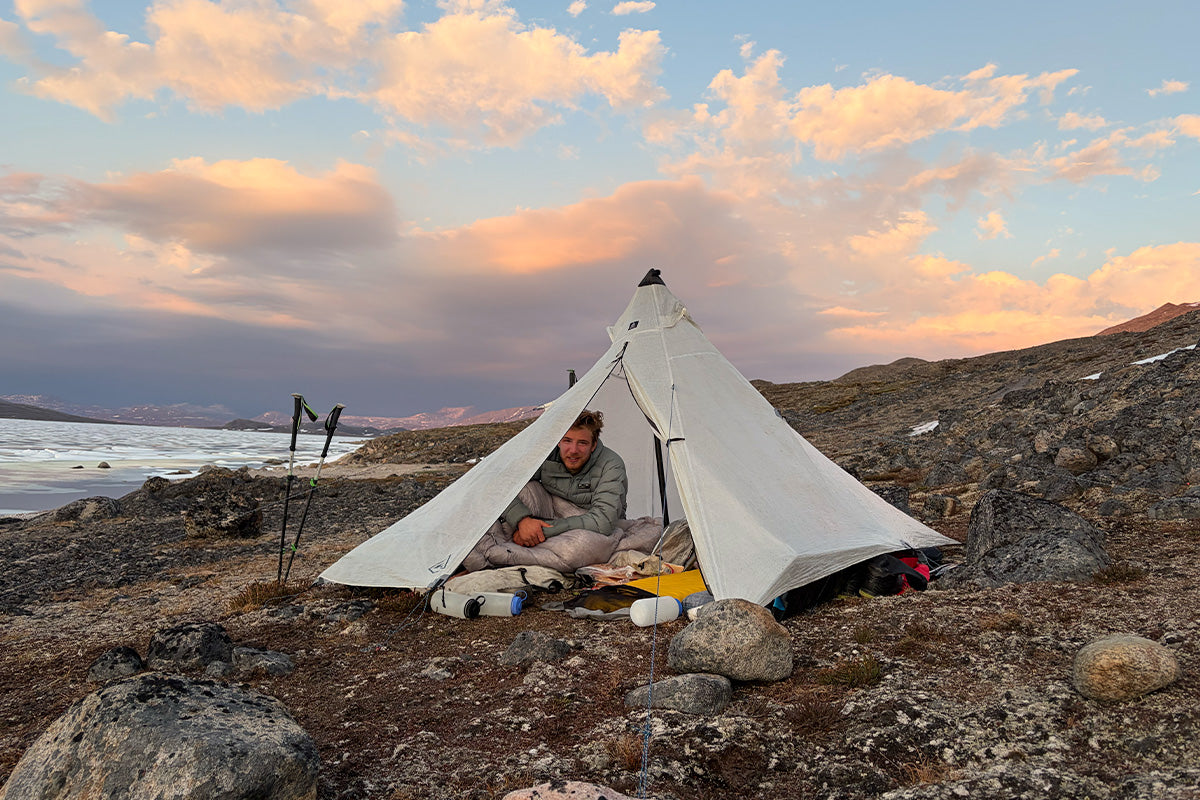
Caleb and Henry continue their circumnavigation of Baffin Island, traveling on from Qikiqtarjuaq to Clyde River over eighteen warped, sunlit days. After their scavenged pulks broke apart, they hiked and paddled through breakup ice, weathered everything from a brief swim to near-hypothermic sleet, and had memorable wildlife encounters (polar bears, walruses, a bowhead whale, and hare-covered islands), along with a stop at ancient stone dwelling ruins — arriving in Clyde River ahead of schedule and about a third of the way around the island, with the next 330-mile leg to Pond Inlet ahead of them.
Words and Photos by Caleb McDaniels @calebjmcdaniels and Henry Penfold @hpenfold
 Hello from Clyde River!
Eighteen days ago, we bid Qikiqtarjuaq farewell and set out on the ice once more.
Before leaving town, we made a last-minute visit to the local dump where we scavenged some sheet metal to fashion new pulks. With miles of flat ice stretching out to the horizon, the prospect of pulling our loads was too tempting to pass up. Our new pulks performed admirably for the first day, gliding across smooth ice with loads exceeding 80 lbs. By the end of the second day, however, both pulks had cracked beyond repair, so we shouldered our packs from that point forward. We soon reached a maze of ridges, hummocks, and holes that would have been impractical to navigate loaded pulks through, so their demise was no great loss. They made a fine addition to the scrap metal pile outside a cabin we came across soon thereafter.

On the whole, this section passed much more smoothly than we had anticipated. Rather than the messy patchwork of sea ice and water we expected to encounter during breakup, we were generally able to paddle open water (albeit often weaving through dense fields of floating ice) or walk across solid ice. Stretches of deteriorating ice occasionally slowed our progress to a crawl, but we still made it here several days ahead of schedule.

Eight days out of Qikiqtarjuaq, we had our first encounter with polar bears. As we paused to enjoy the evening light on an ice sheet north of Cape Hooper, we noticed a trio of white shapes in the distance steadily growing larger: a mother with two cubs. As they came downwind of us, the mother immediately caught our scent and hurriedly shepherded her cubs away from us. It was a distant encounter, but a wonderful moment nonetheless. After mistaking so many distant boulders and patches of snow for bears, it felt exhilarating to finally see the real thing. As we continued north, we also encountered a snowy owl, countless seals, our first walruses, and a bowhead whale glimpsed through the fog. We were surprised to find that many of the isolated outer islands—grass and moss-covered rocks rising from the ocean—were inhabited by great numbers of hares.

In these weeks of endless light, the passage of time has felt warped and difficult to track. On an overcast day, it can be hard to tell whether it is noon or midnight. We routinely find ourselves making breakfast in the evening, or eating dinner at 8am. During our journey here from Qik, we averaged 33-hour days. This meant that while eighteen calendar days passed, we experienced just thirteen days of walking and paddling. Our longest day was nearly 49 hours; 25 hours spent walking and paddling followed by 24 hours sleeping through a headwind! We think our impressive bouts of sleeping are enabled by a combination of exhaustion and confused circadian rhythms. Strange as our schedule has become, we have fallen into a comfortable rhythm of movement and rest as the weeks slide by.

The tundra is growing greener and more fragrant by the day, but even as summer arrives, the weather has been quite varied. Three days ago, after landing on a beach one windless and sunny morning, we decided it was warm enough to go for a swim (“swim” is a generous term; the entire affair lasted roughly one tenth of a second). Just a few days earlier, we felt near-hypothermic as we zigzagged across a disintegrating ice sheet in a mix of heavy mist, sleet, and freezing rain. Baffin’s weather certainly keeps us on our toes!

Towards the end of the section, we had a few longer overland days. It was lovely to see the little tundra flowers in full bloom and hear the bumblebees buzzing around. During one of these stretches, we passed the ruins of some long-abandoned dwellings on the shore of a fjord. Over a dozen stone foundations were set into a shallow hillside and scattered nearby. On some of the ruins, the entryways with their flat stones for roofs were still standing.

It’s hard to believe we’re nearly one-third of the way around Baffin. Tomorrow, we plan to set out on our next section up to Pond Inlet. With countless cliff-lined fjords, glaciers, and deep valleys on the map, we are eager to see what the next 330 miles will bring.
All the best,
Henry and Caleb
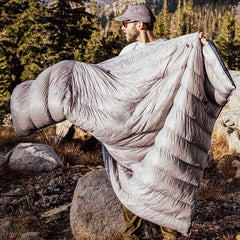
We're proud to support Caleb and Henry on this incredible trip and honored they trust our gear to help make it a reality. Read Part 1 HERE, Part 2 HERE, Part 3 HERE, and more about Caleb's style of adventure and research HERE.