





Words and Photos by Southeast U.S. climber/photographer, Karen Lane @karenklane
 Behind the photos:
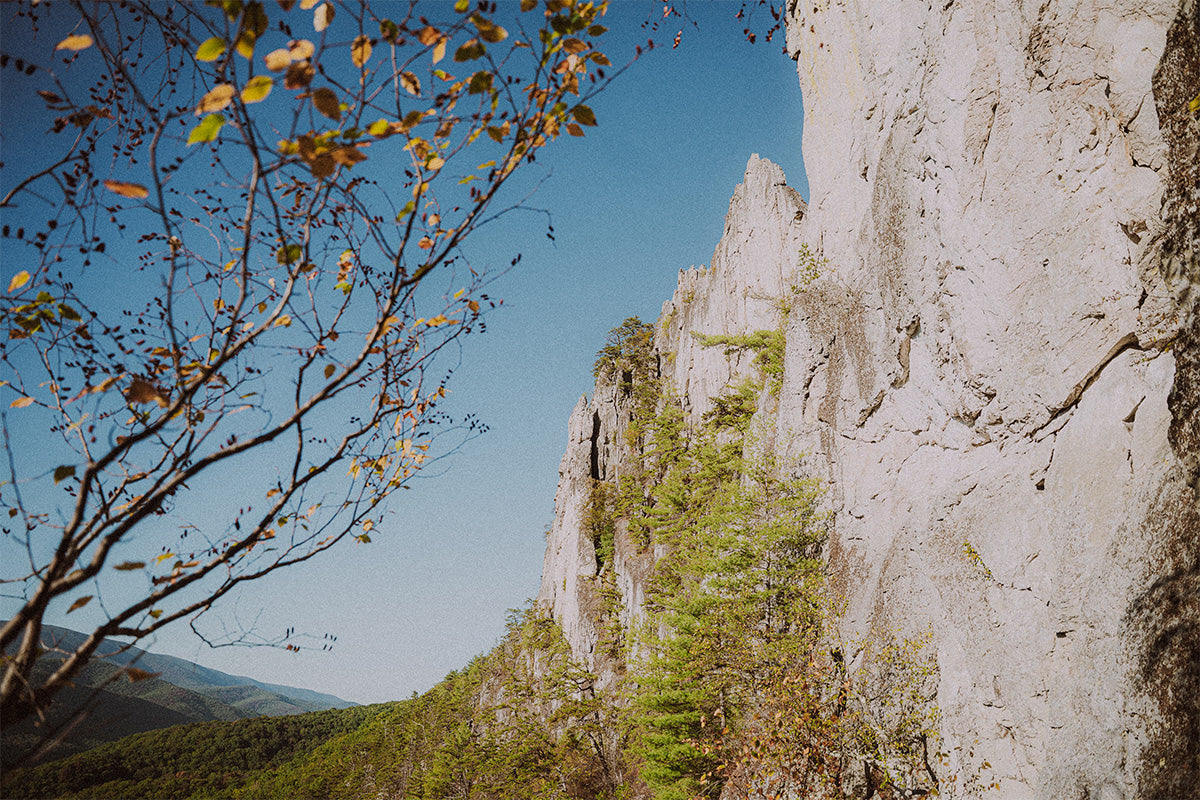
The photos showcase the landscape of Seneca; hiking in, getting ready, and climbing two routes; one newly established climb Green Magic in the Hills 5.14b (Climbed by Amanda Smith in the photos), and one first ascent, Green Glass Door 5.13d (climbed by Andrew Leich). The photos of Andrew on Green Glass Door 5.13d are the actual first ascent.
TLDR: we were there to shoot for Hyperlite and ended up with awesome photos of Green Magic in the Hills and photos of an FA to the left. The East coast is continually left out of climbing media, our mountains are smaller, less vertical, and sometimes harder to access, but as any East-coaster will tell you, our thorns, thick brush, humidity, mosquitos. dirt, add all levels of complexity to the adventure we love. Hopefully the images can show the humidity of the atmosphere, traditional ethics, and beauty of the region in a documentary style of a ‘day out’.
Late summer mornings in the High Country of West Virginia are frosted with thin layers of ice from the dewy night before. The humidity of the East is inescapable even as temperatures drop in anticipation for fall. Cold starts are rare in lower parts of the state in the summertime, but Seneca Rocks is a crag situated in the high country, a unique zone filled with red spruce and a carpet of blueberry and cranberry.
A spine of quartzite fins rocket out of the mountain, silhouetted against hills and hollers. This feature, originally a transitory home for the indigenous Algonquian, Tuscarora, and Seneca nations, later became a site for rock climbing beginning in the 1930s, and remains one of the region's oldest crags. Known for its early hemp-rope ascents, through military training and post-war gear innovations, to modern trad climbing culture, it’s famous in the region for its traditional climbing ethics and bold, yet somehow approachable climbing. Only recently (past 10 years) has there been a spike in bolting the feature’s unfractured faces for the accessibility of sport climbing.
 Originally a 1990s aid route up the Green Wall on the west face of Seneca, Joel Brady (and later Andrew Leich) were the first to bolt and climb a new line up the middle, Green Magic in the Hills, graded 5.14b, making it the first 5.14 climb in Seneca Rocks’ history (ascended in 2022 and 2025 respectively). The pair claim a ‘team ascent’ despite climbing the route years apart, a testament to their camaraderie. The route is three pitches totaling 115 feet, with the final pitch remaining traditional, requiring climbers to place their own gear after the bolted section. Seneca Rocks is known for strict traditional climbing ethics, yet the route required seven carefully placed bolts due to the wall’s lack of natural protection. The crux involves razor-thin edges, some only ⅛ of a fingertip, demanding extreme body tension and precision.

 I followed Joel Brady and Andrew Leich’s journey to establish Green Magic in the Hills online and later through a spectacular article in Highland Outdoors. They were consistent in their documentation of their project; route finding, bolting, beta burning, and finally, Joel, ascending what looked like to be one of the hardest routes in the state and maybe even the region as a whole. Green Wall is just that, a vertical wall blanketed in chartreuse, green crustose lichen contrasting the bone white quartzite wall and exposure of the valley below.


 This is one example of what makes East Coast climbing unique - keeping the green lichen of the wall intact. Lots of climbing areas around the world see the centuries old lichen as a nuisance - a crusty, frictionless, hazard to be brushed away. But just as crusty as the lichen itself, developers here understand the relationship climbers have to the landscape and the organisms that inhabit it. Lichens are a monumental pillar in the health of an ecosystem. They provide habitat, food, and shelter for other organisms and occupy landscapes where no other critters can survive. As important pioneer organisms, they produce acids that chemically weather rocks, breaking them down to form soils for future plants to inhabit, but this happens over thousands of years, since lichens can technically live forever. With this knowledge, the lichen is left on the wall, for its visual appeal, and to continue its work of securing life after we are gone. This story of the lichens motivates me as a photographer to include lichens in my work. This route was a perfect example of this story; one I felt compelled to share.
 Climbs like this one, with its story, exposure, and quilt of lichen, make it an exciting one to photograph. The beauty of the wall really sold our crew on attempting this line and the difficulty of the climb was just icing on the cake. We rallied a crew who had also been following the story of the route, excited to just attempt the line and feel the holds.
 We started off one cold morning in late September. One of the hardest routes in the region requires cold temperatures for maximum friction. But even with ideal temperatures, one can never escape the humidity - but we have been training for this. Climbing in the Southeast is known for its less than ideal conditions. Amanda Smith and Lindsey Frein, two accomplished climbers living just South in Fayetteville, WV, were up for the challenge of rigging ropes for photographs and attempting to project this incredibly hard route.
 The images show Amanda Smith learning the movement of this route. While photographing her beta burn, I saw Andrew was soloing up the first pitch with an extra rope and rack. He had been taking a break from projecting Green Magic by bolting a new line to the left the day before. He sat below Amanda, giving her beta on Green Magic, and she returned the favor by belaying him on what would become a new hard route up the Green Wall, Green Glass Door, 5.13d.
 Andrew had been establishing routes all over Seneca and this was one of the king lines. Climbing Green Magic in the Hills to an obvious break, then continuing up a left face, instead of the original hard boulder on Green Magic. Of course, we were excited to give him a catch while I was already on a rope taking photos. He sent the climb all the way to the second anchor after the 5.13d pitch. Quickly he realized he didn’t have gear to top out the route - since the last pitch is unbolted, a few natural cracks in the face allow for trad gear (removable gear) and traditionally in this area if there is a crack for gear, no bolt is placed. Luckily, I was on route, close to Andrew with my camera, and I pulled up some cams for him to keep the top 35ft to the summit somewhat protected. Though Andrew is an avid free soloist, he was thoughtful to not risk a 60ft fall in front of our crew.

 It was serendipitous to run into Andrew that weekend and watch him climb his first ascent while we were documenting our beta burn on one of his other projects. Andrew later returned to Green Magic in the Hills a few weeks later and sent, claiming a 5.14c grade. The route took both Joel and Andrew hundreds of attempts, but you be the judge.


 We were there to photograph the Vertex 32 backpack, a lightweight pack that is perfect for the Stairmaster approach of Seneca. We wanted to capture the pack in an East coast setting, trying to get close to the Appalachian ‘alpine’ feel. There's amazing multi-pitch climbing all over the East, Looking Glass, Linville, and the Gunks. Seneca has a reputation for being ‘easier’ with more approachable pitches, but this newer route development is starting to change perspectives. Climbing in the East also has a reputation to be dirty and insecure due to local ethics on cleaning. On this route, with the lichen kept in-tact, we wanted to celebrate the green throughout the collection of images. Exaggerate the color in a vintage wardrobe, texturize the postproduction, keep the old Seneca feel, but in 2025. We also made sure to document the whole day, from packing in and out, hiking, and ice cream snacks that end most everyone’s day at the general store below. We wanted to represent the raw feel for climbing at one of the United States oldest crags.