





Words from Rich Hohne, Photos by Skwala Fishing
 Most of us get invited on trips we never take.
Our justifications for saying “no” are usually reasonable. Time. Cost. Logistics. Calendars that already feel full. Work’s ravenous appetite. Life always feels busy. We say “no” by default—taking the easier option and assuming we’ll get another chance.
Saying “yes” is like raising your hand in class; you voluntarily commit to planning, scheduling, expending resources, negotiating time, perhaps disappointing someone. We can only overcome inertia by expending energy.
 When the invite floated my way six months earlier, I hedged. Though exciting, the plan felt ambitious. Remote. Expensive. Long. Even though I work in the fly fishing industry, I negotiate the same constraints you probably face—family, a full-time office job, the quiet weight that settles when you’re gone longer than feels comfortable. I hemmed and hawed for months before finally buying the damn ticket. In November, the trip still felt hypothetical. Then, Holiday commitments and new year demands kept me distracted.
Finally, a week out, I started researching where the heck we were going.
 Te Ika-a-Māui, aka the North Island of New Zealand, a place I’d only glimpsed through airport windows while waiting for flights to the venerable South Island. Most anglers skip the North Island, assuming it has more people, fewer rivers of repute, less wildness.
Turns out, we might be wrong.
I met up with Miles Nolte, who works with us at Skwala, at his home in Wellington. The following morning, we drove north on State Highway 1. Viewed from a car window, the Capital City transforms with surprising speed into forested hillsides and then emerald pastures. We followed wide, agricultural floodplains north toward mountains that still shelter wilderness—both of us excited in that restrained way that comes from not wanting to jinx what’s ahead. Miles has a steady, grounded presence. He’s the kind of person you want beside you as you hurtle toward uncertain plans, and the road stretches farther than expected.
 We met up with Oliver Jones on a river somewhere in the central plateau as he was finishing a guide day and we were stretching our legs after a five-hour drive. His text read, “Don’t ask about the fishing,” followed by a skunk emoji. “They’re on the feed, but we couldn’t seal the deal.”
Originally from Kenya and barely past 30, Oliver has seemingly done everything—guiding rivers in Wyoming, starting and operating wilderness camps in the Central African Republic, helping lead an expedition that landed the first ever goliath tigerfish on fly. For the past decade, he’s guided in New Zealand for Chris Jolly Outdoors, one of the country’s premier adventure outfitters. His stories sound exaggerated until you realize he doesn’t need to embellish.
Together, Oli and Miles set the tone for the week—not rushed, not precious, not posturing, just quietly dialed. That tone mattered.
Because once the helicopter lifted off and disappeared over the ridge with the three of us strapped inside, there was no turning back.
The flight took about twenty minutes. The pilot touched down, waited long enough for us to unload, then disappeared within seconds, leaving us utterly and spectacularly alone. No roads. No access. No other humans. Just us, the forest, and the water for the next seven days.
 The river became our trail.
It was higher than expected, swollen from ten days of rain—higher, in fact, than even Oli had ever seen it before. So high that it had swallowed the entirety of the streambed and now licked the edges of the canyon. We were forced to walk in it and up it, to make crossings every hundred yards or so that tested the upper edges of our waders. This was not Montana walk-wade fishing, carelessly skipping up a bank. Every step required full attention. Every crossing demanded decisions. Some were careful. Some were uncomfortable. Occasionally, we stripped out of our waders and swam. We carried ropes. We moved deliberately. And we did all of it while carrying fifty-pound packs.
 Leaving the river meant fighting through bush—dense, sharp, untracked and unforgiving. Downed trees and tight corridors. Terrain that slowed progress and punished impatience. There was no autopilot. No zoning out. We earned every step.
And then there was the fishing.
 Our daily rhythms felt simultaneously simple and profound. Walk upriver. Scan every run. Find fish. Make a plan. Try to execute. Rotate through. One rod at a time. Everyone gets fair shots. This was true team fishing. We worked together. Sharing each success and failure. Most holes held fish—sometimes shocking numbers. Five- to ten-pound trout finning and feeding in blue pools that felt untouched.
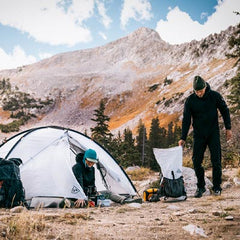
After eight or so hours, we’d find camp, pitch tents, cook dinner, and relive the day around a fire as darkness settled. Sleep came easily. So did waking at dawn for riverside coffee.
 A close friend back home in Bozeman often says, “Buy the ticket.” I carry that phrase with me, even if I don’t always live it instinctively. The idea isn’t reckless; it’s intentional—a reminder that committing to experiences, even (or maybe especially) when you don’t have all the variables figured out, is the only way to embrace opportunities.
On the second-to-last day, walking upriver in the early light, that phrase stepped into my consciousness.
I realized how close I’d come to missing this experience. I had so many reasons—good reasons, responsible reasons—to say “no.” I almost stayed home and let someone else take my spot—never knowing what I’d passed up.
Instead, it became one of the most meaningful fishing experiences of my life.
 Trips like this don’t just give you fish or photos or stories. They recalibrate you. They remind you that discomfort is often the point. That the best experiences rarely fit your calendar. That sometimes the right move is to commit first and trust yourself to figure out the rest. Of course, we all have limitations. I’d like to experience countless places that will probably never be realistic. But when an opportunity appears that feels inconvenient but possible—take it.
I’m thankful I bought the ticket.
We were stoked to help the crew from Skwala get after what they were after. Skwala builds gear for fly anglers who are constantly pushing the limits of their fishing adventures. Spearheaded by founder Kevin Sloan, the Skwala team is obsessed with innovation that utilizes leading materials, thoughtful design, and unsurpassed construction. Skwala builds waders, footwear, outerwear, insulation, and sportswear that are built to fish and always ready for the task at hand. Explore the full line-up at www.skwalafishing.com.